From sensor to insight
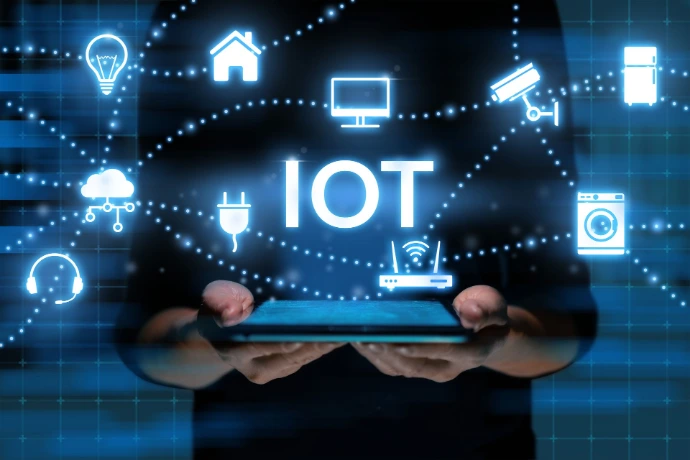
With the Internet of Things (IoT), you make buildings,
machines and infrastructure measurable and connected. Sensors collect
information from the physical world and wirelessly send it to a
gateway, cloud environment or central IoT platform. This allows you to monitor installations remotely, detect deviations faster and use data to manage processes
more efficiently.
Master Chips offers a comprehensive range of IoT-solutions. From wireless sensors and LoRaWAN-gateways to mobile (cellular) IoT-connectivity, tracking and industrial edge controllers.
The offering includes various communication technologies, including LoRaWAN, NB-IoT, LTE-M (LTE Cat M1), Wi-Fi, Bluetooth, and Ethernet.
IoT sensors
Wireless sensors for measuring and monitoring environment, energy, and technical installations
IoT-gateways
Gateways for collecting and forwarding sensor data and building private IoT and LoRaWAN networks.
Industrial IoT & Edge Controllers
Industrial controllers and Raspberry Pi-based systems.
Tracking & Telematics
Tracking solutions for mobile applications.
Dashboards and IoT platforms
Master Chips not only provides hardware but also ensures a tailored IoT platform.
The right technology for every IoT application
Not every IoT project requires the same communication technology. A battery-powered temperature sensor in a building, for example, has different requirements than a tracker in a vehicle or an industrial controller that continuously processes data.
That is why at Master Chips we do not start from a technology or product, but from your application.
LoRaWAN is particularly suitable for sensors that need to transmit small amounts of data over relatively large distances with low energy consumption. A dedicated LoRaWAN gateway also allows for the development of a private network and the coverage to be tailored to the building or site.
NB-IoT and LTE-M make direct use of mobile networks and are designed for connected devices with relatively low data consumption. This allows a sensor in locations without its own LoRaWAN infrastructure to communicate directly via the mobile network.
For applications that require more local processing, interfaces, or control, Industrial IoT and edge controllers can be deployed.

From hardware to complete solution
An IoT project does not stop at selecting a sensor. The sensor must communicate, the data must be collected, and ultimately the information must be usable for the user.
That is why Master Chips can provide support for various parts of the project:
Sensor → Network → Gateway → Platform → Dashboard → Alarm or action
We assist in choosing the right sensor and communication technology, the network architecture, gateways and connectivity, and the integration of the data into a central platform.
This way, there is no loose collection of connected devices, but an integrated solution that provides usable information.
Our latest products
See what’s new in our Internet of Things category!
Frequently asked questions
With dual SIM, two SIM cards can be used in one router. This can be useful for automatically switching to a second provider when the primary mobile network is unavailable or has insufficient coverage.